
|
March 4th, 12pm-1pm
From Sparse Sensors to Continuous Fields: STRIDE for Spatiotemporal ReconstructionYanjie Tong
Advisor: Prof. Peng Chen
|
 |
ABSTRACT
We introduce STRIDE (Spatio-Temporal Recurrent Implicit DEcoder), a novel deep learning framework for reconstructing high-dimensional spatiotemporal fields from sparse point-sensor measurements. Existing approaches often struggle to generalize across trajectories and parameter settings, or rely on discretization-tied decoders that do not naturally transfer across meshes and resolutions. Our proposed approach is a two-stage framework which maps a short window of sensor measurements to a latent state with a temporal encoder and reconstructs the field at arbitrary query locations with a modulated implicit neural representation (INR) decoder. Using the Fourier Multi-Component and Multi-Layer Neural Network (FMMNN) as the INR backbone improves representation of complex spatial fields and yields more stable optimization than sine-based INRs. We provide a conditional theoretical justification: under stable delay observability of point measurements on a low-dimensional parametric invariant set, the reconstruction operator factors through a finite-dimensional embedding, making STRIDE-type architectures natural approximators. Experiments on four challenging benchmarks spanning chaotic dynamics and wave propagation show that STRIDE outperforms strong baselines under extremely sparse sensing, supports super-resolution, and remains robust to noise.
BIO
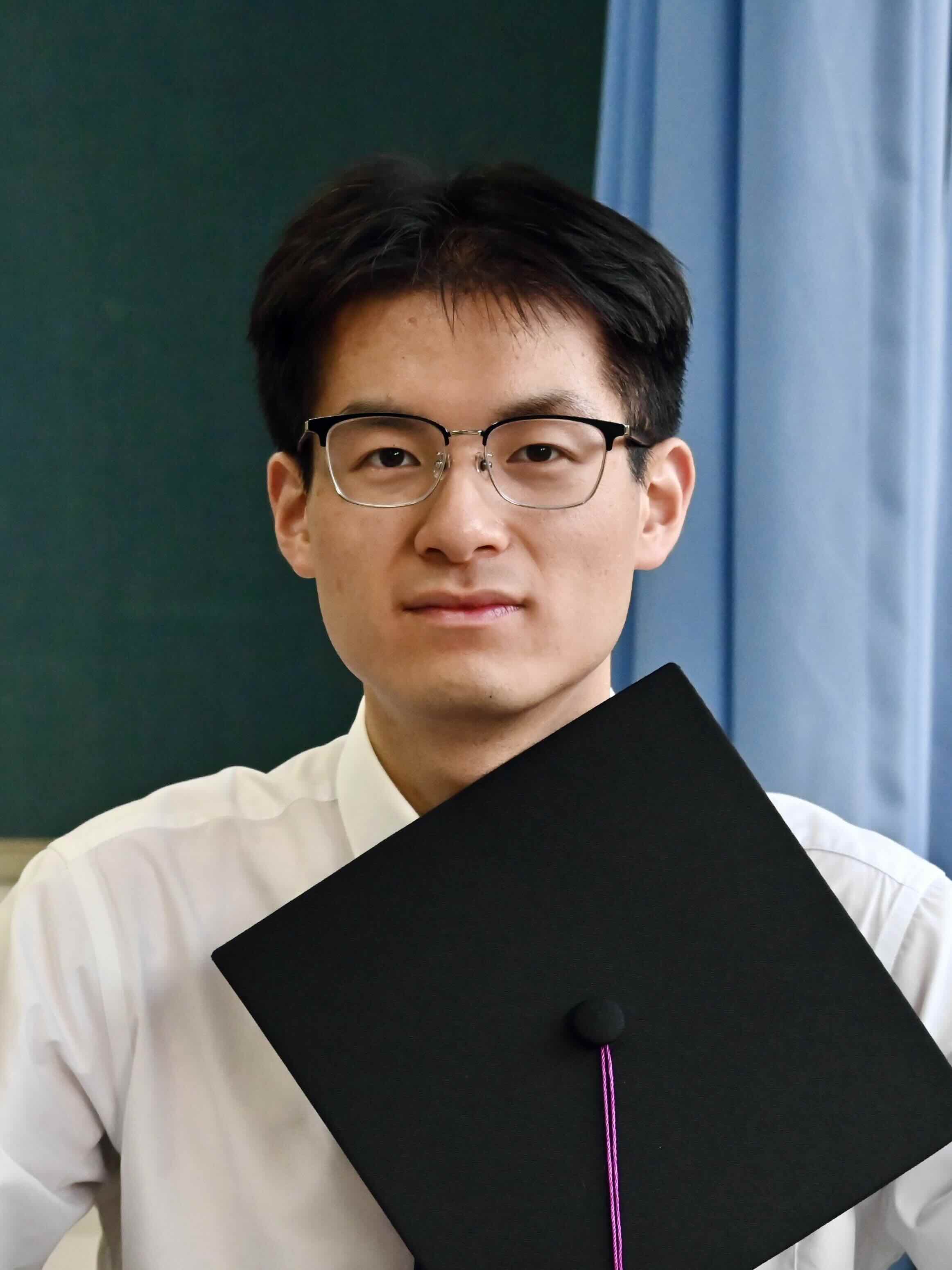
Yanjie Tong is a second-year CSE Ph.D. student advised by Dr. Peng Chen. He earned both his B.S. in Mathematics and Physics and his B.Eng. in Energy and Power Engineering at Tsinghua University. His research focuses on methods for learning latent dynamics in low-dimensional spaces and their application to real-world problems.